Showing posts with label Sunday Night Scotch. Show all posts

Sunday, November 17, 2013

Can A Slingshot Take Down The AWS Juggernaut?

If your purpose in life is to entertain the gods, you might as well put on a good show.
 --Unknown

Amazon's Re:Invent show last week turned out to be quite a coming out party for the predominant infrastructure service provider. There were a number of interesting announcements that moved the stocks of perceived competitors, and of course, there was a disproportionately large showing of attendees at the Venetian in Las Vegas. For me, the highlight was provided by good friend, and super smart VC, Jerry Chen, who went on  The Cube to lay down the gauntlet starting at about 7:00 in the video below:


Watch live video from SiliconANGLE.com on Justin.tv

The salient point Jerry made was the comparison between an ascendant Amazon AWS and the now-decidedly incumbent Microsoft circa the 1990's. His argument is that there are really two investable bets to make (well, he said three, but the third is less interesting to me). The first is that there are companies to be formed that can make AWS more enterprise-ready, and the second is that you can invest in someone that will take down AWS. If nothing else, it is heartening to see Jerry has taken up the mantle of the venture capitalist, and has pointed to the next big hill for the army to conquer. As entrepreneurial cannon fodder in this battle, I greatly appreciate the affirmation.

Well, since I can't sleep well on airplanes, and I had the misfortune of taking an overnight flight home from Las Vegas, I had plenty of time to think about this matter. After reaching back into my memories as a newly minted engineer in 1991-1993, it is obvious that history does indeed rhyme if it does not repeat. Hence, I think I have come to a conclusion on which will be the better bet if I were investing venture money right now.

A Tale of Two Microsofts

Having the pleasure of attending some of the original Win32 Developer's conferences, the Microsoft PDC's, during the early 90's, as well as the WinHEC conferences up until 2008, I had a semi-privileged, front row view of the revolution that Microsoft led over the course of a decade. Given the day-to-day reality in which we operate, it is easy to forget that the world at the time of the 1993 PDC was radically different than what we have today. In fact, most readers may find my observations of being a Windows "dev" back then quite amusing.

As I recall, developing code for Windows before Windows NT was released was a trying process. The development tools before Visual C++ were not that friendly. The operating systems were either very buggy and unreleased (as in the 32 bit NT), or super-duper buggy and shipping (Windows 3.0, 3.1, 3.11). In the case of the latter releases, you had no meaningful memory isolation between tasks, and so a simple coding typo could take down the whole box while you were working. Having learned to code in the Berkeley and AT&T UNIX operating systems, it felt like I was playing with a toy rather than a tool of enterprise transformation.

Back then, the "real" systems that businesses ran on were either UNIX-based mid range servers, or mainframes. The PC client was really just an over-powered terminal that also had some desktop apps, as well as file and printer sharing. Strategy discussions in PC software companies centered around how overpowered the clients were in comparison to the big iron, and what that fact foretold about the future. Indeed, the developers' conferences were largely full of optimistic young developers trying to change the role of the PC architecture. The rhetoric coming from Gates, Ballmer, and Allchin included lots of chest-pounding bravado about how good the next generation would be, and how it would take on a huge role in the enterprise - if only we developers would agree to write awesome new apps for Win32. We all would go home with palpable excitement and a religious zeal.

A little over a decade later, the world was radically changed. Perhaps not for the better. Substantially all of the mid-range systems vendors had vanished. Windows was dominating both the client and well as the back office of enterprises everywhere. The ecosystem that had developed all those awesome Windows apps had largely been cannibalized by Microsoft, and all those developers had moved on to writing web apps or other cool, Linux-based  things that were out of the way of the perceived MS predatory machinery. It was here that compute and storage virtualization emerged as dominant technologies. It is easy to argue that AWS and VMware tipped the datacenter market from the new incumbents right here.

Amazon Looks More Like the MS of the 90's

Last week's conference was full of developers. The rhetoric brought back memories of the 90's. The show floor was full of small, venture-funded companies. The representatives of the big incumbents were trying to make themselves invisible. Everyone, including the VC's, were talking about how AWS was not ready for the enterprise - yet. Although rumors suggest that AWS is a $5 billion revenue stream, it does not look like the big players are using it yet.

It's hard to envision that AWS can be tipped over when it's user base is not the demanding enterprises that make up the bulk of IT spend in the market. The fact that it got to this point based on the grass-roots support of a big developer community makes it very scary. People are right to be afraid that this company could be the next big IT monopolist. However, if you are an investor, would you consider it an easier bet to take them down, or to help them achieve the dominance they seek? The key, in my opinion, rests with Amazon. If they take a page from their neighbors in Redmond, and eat their ecosystem, the community will move on very quickly, and the bet is an easy one.


Monday, October 28, 2013

Technology, The Mirage of Shareholder Value, and Why Icahn Should Just Retire


“We may see the small Value God has for Riches, by the People he gives them to.”
Alexander Pope (1688-1744)

There are some days that I feel as if I am a late night talk show host blessed with a particularly inept politician. This past week was particularly fortuitous for me, as Carl Icahn has proven himself to be a gift that keeps on giving. I have been fairly blunt in my assessments of his spectacular effort to morph the Dell LBO into a goat rodeo (See here and here.) Hence, it makes me crazy that he managed to show up in the headlines once again this week, engaging in the same fatuous behavior that makes him a caricature of what my friends in finance would call "dumb money". This time, despite the ostensibly impossible odds of success, he decided to take on Apple. For a quick primer, the NY Times Dealbook blog does a great job:

Icahn Amps Up Pressure on Apple, but His Stake Limits His Leverage

It is hard to overstate the the pointlessness of this move. As I type this, Apple's market capitalization is an immense $484 billion. For Icahn to get the 5% stake in Apple needed to incite his usual proxy cat fight, he would need to come up with well north of $20 billion in cash. Which would be fine, except that he just doesn't have that kind of money. How do we know?  Because he was such an abject failure at topping the $24.4 billion offer that Michael Dell and Silver Lake were making for Dell. With bluffing skills like these, he needs to be kept away from the poker table at all costs. I haven't had this much fun watching M&A since a fish oil company called Zapata tried to buy an Internet company 6 times its size with stock in during the .COM boom. Here's some advice for Carl: Stick to raiding businesses where you might have some rudimentary understanding of their operations, like, say, lumber, fish oil, or buggy whips. If you you can't find any, it is far better to quit at the top of your game rather than have us remember you as a laughing stock.

With that said, Icahn is but a pathological symptom of a much bigger problem in the industry: Management's over reliance on optimizing for a high stock price rather than for building a sustainable business. This is especially true for the information technology industry, where the reductionist private equity strategy of cutting research and development in order to run the business for cash flows makes no sense. The fact is that no business can really be run as an accounting identity. In technology however, the product sets and platforms have a half life measured in low single-digit years. Killing a single dollar of R&D will set up for certain failure two years into the future. Tragically, stock prices get managed in 90 day intervals, so, if you are a CEO, firing your entire engineering organization will make you look like a hero in 12 months. In 30 months, you will likely yourself be fired; and your company, your customers, and your employees will be irremediably damaged.

The correct way to run a technology business - any business, for that matter - is to focus on the needs of the customer first. Build a world class product and solution set. Provide a lavish support infrastructure and build lasting relationships. The only way to do this is to assemble a talented and productive team, and show them that their contributions are valued. Build their loyalty. Enable them to to delight customers, and support them and their needs. The wants of the typical shareholder are so far removed from business success because the typical institutional shareholder is far removed from the customer. Does Carl Ichan care about the product needs of Apple's or Dell's customers? Absolutely not. He is clearly eyeing the cash in the bank and would hire new management to implement his redistributive strategy.

Managing for shareholder value rather than for happy customers is a problem that has reached almost crisis proportions. Thankfully, at least in technology, there are always cadres of small nimble companies out there who focus on their customers. They are the ones that are privately held and VC-backed, however. In most successful companies backed by venture capital, not only are the employees focused on the customer, but so are the investors. Maybe it's not a coincidence then, but these investors seem to score some of the most amazing returns for their money over the long term. Hopefully that will not go unnoticed. In business, customers - and not shareholders - always come first.


Sunday, October 6, 2013

Sunday Night Scotch: Disruption Is So... Well... Disruptive

The reason that God was able to create the world in seven days is He didn't have to worry about the installed base.  - Enzo Torresi

Maybe it's a sad testament to the human condition, but the technology industry does not seem to lend itself to attracting individuals with humility or self awareness. Since my very early days as a junior software engineer, I have noted that it is only a matter of time before many archetypical tech nerds, having achieved a modicum of monetary success, start to behave erratically. Before long, you see them standing on top of the roof at corporate headquarters, laughing maniacally. In a thunderstorm. Waiving a five-iron in the air. I'll grant that this happens in other professions as well, but there's something about the rags-to-riches nature of tech that makes it all the more poignant.

If you are an executive in a leadership position at any firm, it therefore follows that you need to go through the history of other people's mistakes obsessively so you learn from them. (I recommend doing so very clinically - like the NTSB examining the wreckage of an airplane crash.) What you inevitably find, tragically, is that history really does rhyme even if it doesn't repeat. With that thought in mind, I present to you the scariest part of my reading list from last week: The Globe and Mail's investigative piece on the failure of Blackberry:

In it, you'll find a freakish retelling of pretty much every cliché of every tech downfall you can imagine. If you are a technology leader, and you'd like to engage in some negative reinforcement therapy, I recommend it highly. Likewise, if you need an excuse to have a strong drink, you'll find all you need there. Here are some of my thoughts:

Disruption Is Never Evident Until After The Fact

In her book entitled Being Wrong: Adventures In The Margin Of Error, Katherine Schulz states that being wrong feels exactly like being right. What we remember most painfully is the moment when we realize we are wrong. What will make you cringe, therefore, is the fact that much of the investigative narrative does not occur in the months after the iPhone's market success in 2007 and 2008. It is a story set in events of 2012 and maybe late 2011. It wasn't until then that the mobile phone market had been disrupted to the point where Blackberry sales were beginning a secular, irreversible decline. That is a long time. Friends, that is what disruption looks like.

The point here is that you can't advertise a sea change. Smart people do not screw up this badly unless they are completely unprepared. By definition, a technology market can't be disrupted if all the players were anticipating the change. So, all you Storage Geeks take note: Things like flash technology are really more evolutionary. Everyone knows about them and they are all making bets. It is unlikely that anyone will go out of business. In fact, recent failed IPO's are testament to that. True disruption sneaks up on you.

Listening To Your Customers Can Kill You Too

Conventional business wisdom would have executives in a bear-hug with customers, listening and catering intently to their every whim. In a disruptive situation, the customers you are listening to aren't the ones that are going to rock your world. It is the early adopters and the rebels that are driving the change. A large, established technology company cannot pay attention to these people because they do not represent a viably large market. When it would have mattered to do otherwise, Blackberry was clearly making decisions based on the needs of their huge revenue base: the one that was paying them for physical keyboards on their phones. They were doing precisely the correct thing. They were wrong to do so.

Just hiring a CTO to go watch these people wont work either. I know exactly what it feels like to point out that a fringe minority has a better idea about how to do things. In a publicly held company, the business worships at the "church of what's happening now". There is no accounting gimmick or spreadsheet that you can conjure, which makes an ROI case for investing in a disruptive technology. You will lose your case every time. When the return is 4 years into the future, no one will care. This is why there are venture capitalists.

Finally, we can see what can go wrong when you send off  a bunch of rebels to "do the right thing" as Blackberry did with the touch screen products. They can easily lose touch with your customer base, and build something that your existing customers wont transition to. At the same time, they may not get any new customers either, unless they are truly brilliant in their execution.

No One Can Explain the Ten Year Run Apple Has Had

When the history books are written for business over the last decade, I am not sure how they will be able to distill the moves Apple made into a real repeatable formula. It is not lost on me the hypocrisy of criticizing the seemingly stupid, calcified, large incumbent technology organizations, when the player bringing the disruption is actually a big company, too. The ability to attack huge, seemingly unrelated markets from a position of financial strength helped. Not having to drag an existing user base along also seemed to go a long way. So did the organizational structure that protected the development of these new products from the vicissitudes brought forth by the markets. ...But getting it right every time on these giant bets? That is pure genius or pure luck.

Cheers!

Friday, September 13, 2013

My Stock Got Involved in a Bidding War With a Carl Icahn, And All I Got Was 30 Cents

I really can't resist commenting about this topic, so even though it might bore many of you, I'm going to delve into things Dell for one last time... at least for now. As you must surely know, we were greeted on Monday morning with news from all manner of news outlets that the Ichan-led consortium had decided to pull out of the running for acquiring Dell. As reported at the WSJ today, it looks like the takeover is now a done deal: (link may require a subscription)

Dell Shareholders Approve Buyout

So, barring any last-minute heroics from unknown parties, it looks like the original deal proposed earlier this year is going down largely unchanged from its original terms. This leaves us with a lot of things to ponder going forward about the business of being an IT infrastructure player. As I blogged previously, the deal also presents an interesting barometer of risk tolerance in the post bubble, post-2008 world. Finally, there's the fact that corporate raiders... err, I mean activist shareholders... seem to have jumped the shark with this deal.

Let's deal with Icahn first, since he has been an endless source of amusement for me. I love, love, LOVE it when a guy like him parrots democratic principles while trying his best to squeeze money out of anyone he can. One thing that I have learned over the years is that a corporation is anything but a democracy. Frankly, large or small, its much closer to a dictatorship when it works best. There is one important distinction: if you are an employee, customer, stockholder, or all of these, you can feel free to walk away at any time. You can even sell the stock short and say mean things on message boards. Except for that, it's just a matter of scale. Are we with Fidel, Saddam, or Lenin? The notion that the shareholders can tweak management is valid only on the margin and in extreme cases. Maybe you can argue that Dell was such a case, but, as you can see, it was very easy for management to do what they saw fit. Management sets the rules, and then can change them as is expedient. If you want to fire them all, you best have a plan to replace them quickly, lest you become the guy that has to run the place.

Which segues into the second point: Icahn clearly never wanted to buy Dell. He never had the money to buy Dell. Even if he had the money, he had no credible plan to rehabilitate Dell. Heck, I'd be astonished if he could carry Michael's briefcase successfully. When Blackstone bowed out earlier this year, he had an opportunity to gracefully leave the table with a profit, and spare himself the embarrassment of last week. If he really believed in the value proposition of owning a private Dell, he could have toned down the incendiary rhetoric, and tried to roll his position into a stake in the new entity. There were so many ways to win... Instead, he lost a very public battle in a circus setting of his own creation. As a result, everyone now knows what his credit limit is. Everyone now knows when he's in over his head. He's going after Apple now, which is 20 times the size of Dell. I wonder how worried the guys in Cupertino are these days.

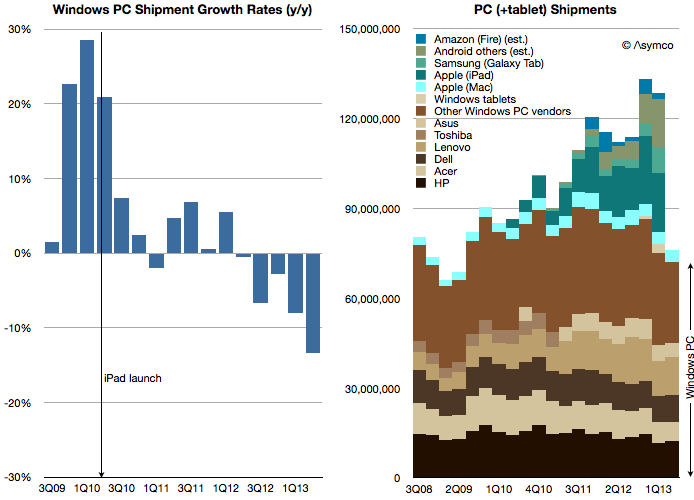
All that said, there is a special corner in Hell being reserved for the people that have to carry on in the private entity about to be created. The vast majority of the revenue, the supply chain, and the employee base are tied to a product stream that is in secular decline. The rumors are that they are thinking about a $2 billion cut in operating expenditures. (read massive layoff) As I have blogged previously, searching for loose change underneath the drivers' seat is no substitute for actually taking the wheel and trying to go somewhere. Meanwhile, Horace Dediu puts together some charts that tell a damning story about where the car is going:


What happens if sales keep declining? More cuts, maybe? What part of that growing market for Android, and iOS mobile devices does the Intel/Microsoft/Dell troika have? Let's ask the bigger question: How much is Dell really going to invest to keep a share of this market, and why do they keep talking about it so much? One thing is certain: If they are going to ramp up that enterprise business to replace client revenue, it will take a herculean investment to even get things close. The strategy of making small purchases to grow the business will not yield results quickly enough, nor is the prospect of having to integrate and manage all those organizations a particularly easy path. One is left to wonder if there aren't one or two really big transactions to follow this one. Then again, they are a private company now. Does it really matter any more?

With that, off to hit the scotch...


Sunday, September 8, 2013

Sunday Night Scotch: Andreesen Wrong About Nearly Everything, But That's His Business Model and He Will Win Anyway


...You fell victim to one of the classic blunders! The most famous of which is "never get involved in a land war in Asia," but only slightly less well-known is this: "Never go in against a Sicilian when DEATH is on the line!" [He laughs hysterically, but suddenly freezes mid-laugh and dies]

- Vizzini from "The Princess Bride"

I thought it would be useful to reprise last Sunday's blog with a counterpoint. I think I may have mistakenly created the impression that I had some sort of bias against VMware CEO Pat Gelsinger when I opined last week on his outburst regarding the relative merits of ARM vs. x86. That was certainly not my intent, but the problem is that Mr. Gelsinger got into an argument with the wrong guy: he decided to take on a venture capitalist. There are a number of problems with this, and so I thought I would waste a few words to try and explain the relative difference between the ways the two men frame their opinions.

Let's begin with a simplistic explanation of portfolio theory. Specifically venture portfolios. It is often overlooked precisely how Mr. Andreesen makes his money. No one should be surprised by this, but a typical VC is managing some pretty immense risks. On the flip side, he or she has some outsize payouts should one of the immense risks actually pan out. On the face of it, the math starts to look astonishing: A 10-20% win ratio will generate some bubbly returns even after the exorbitant fees are taken out.

So when you parse the publicly held opinion of a VC, you need to keep in mind that they are making crazy bets all day with huge sums of money. Moderately crazy bets wont do, because they can't generate the returns needed to justify the fees. They also make lots of these crazy bets to manage the risk. Most importantly, they don't need to make sense relative to one another. For example you may be wondering how we could end up in a server-less world but at the same time, processors that can't run VMs will flourish. Don't do that. It doesn't make sense.

The point is that Mark Andreesen lives in a world of extreme outcomes. All of his opinions need to sound crazy and unhinged. That was the beauty of putting him on the VMworld panel discussion. Even more interestingly, we will never remember him for the 80% of his portfolio that goes mediocre. Being wrong is the most likely outcome. Like we do for professional sports athletes, we will remember him and lionize him for the big wins.

Back to the discussion panel, the CEO of VMware lives in a diametrically opposed world. VMware is a very unique company, but they are still governed by the need to produce stable performance for their customers and employees. They actually have to be right most of the time, or else things will go badly for everyone. To my previous point, Pat Gelsinger and Mark Andreesen should disagree about a lot of things. If not, one of them is going to be a failure.

That said, one or two of the prognostications will eventually pan out, much to everyone's surprise, and will result in a radically changed world. You can't blame a VC for trying to disrupt the status quo. On the other hand, you can be quite alarmed when a CEO lacks the imagination to consider the factors that may lead to his firm's demise. (That was the point of my post.) We know from experience that disruption is inevitable, and stability is fleeting at best. Makes you want to align with the disruptors, doesn't it?


Sunday, August 25, 2013

Sunday Night Scotch: Every Day, A New Reason to Start a Company


All bad precedents begin as justifiable measures.
- Julius Caesar


One of the non-tech items that caught my eye over the last week was the interesting news from UPS that was covered by all manner of news outlets, perhaps most colorfully by MarketWatch's Jim Jelter in the video spot called.... drumroll please... "Why Your Boss Is Dumping Your Wife". The video is after the break below in case you missed the news. To summarize, UPS decided that they were going to deny coverage to working spouses of employees if they were at a company that also offered health insurance. Regardless of the political excuses, this idea was inevitable: My former employer was imposing a non-trivial surcharge to employees of working spouses who were similarly eligible - and this was back in 2008. Oh, well. I guess both Dell and UPS are OK with not being on the Fortune "Best Companies To Work For" list.

I think this is a great opportunity to try and understand how something like this could seem like a good idea to anyone. First, a look at the math: According to the Health Connector website here in Massachusetts, the difference between insuring me, my spouse, and my two kids, and dropping my spouse, works out to be between $320 and $550 per month depending on the plan. That works out to $4-6K per year in cost, of which $3-4K might be paid by the company.  UPS claims that this will affect 15,000 employees, so that tops out at a nice round $60 million, or roughly 7% of net income in the last 12 months. (By coincidence, that is the exact figure the company mentions.)

Admittedly, there are two ways of looking at this: On the one hand, some might say that health benefits have become too extravagant to be shouldered by the shareholders of the business. It's the shareholder's money after all. I am way out on the other extreme, however: Why does the business and its leadership suck so bad, that this is the only scheme they can conjure to increase shareholder value? Professing your lack of love for your employees, prima facie like this, is surely not a way to make your customers happier. Moreover, that earnings bump next year will likely do nothing for the stock price. Analysts know well that it does not represent real growth in the business. So then, why bother?

Like human beings, large organizations are very complex. Also like humans, to get an idea of what really propels organizations, you need to observe them at the moments where they are least inhibited: In this case, a time of despair. The economy is rather flat. The numbers are likely to disappoint. Somebody is going to lose a bonus. This is where discipline counts. Real leadership would dictate that you go talk to customers and find out what can be done to grow their businesses and yours. Mediocre leadership would dispatch a team of "efficiency experts" to see if they can find coins under the sofa cushions in the employee lounge. Doing the former is hard. It's much easier to do the latter. Each time you opt for the latter, you only make things worse down the road.

The point here, is that it is very easy for big businesses to lose their compass a little bit at a time. The proven way to make money is by focusing on addressing the needs of customers. Whenever there are substantial resources devoted away from that one singular focus, it almost always leads to a bad outcome. The reason startups can do so well is because they have no choice but to focus on their customers or perish. The reason the Googles and the Microsofts of the world got so successful is because they enabled their employees to do the same in scale. Indeed, that $4K per annum is noise compared to the profits that they bring per employee.

As for my part, if you happen to end up working for the company that I want to build, I can assure you that your spouses will be covered. Your espresso will be provided. Your scotch will be free. We'll throw in a few meals as well. In return, I'm going to expect that you will devote all your energy toward delighting customers. Seems like a good deal, but I assure you that it's the much harder path. It's much more rewarding, though. This is something I know from experience.


Monday, August 5, 2013

Sunday Night Scotch: Do I see Checkmate? Did Michael just win?

So, the big news going into the weekend was the outcome of the latest round of negotiations between the Silver Lake/MSD team and Dell's buyout committee, as Arik Hesseldahl notes in the Wall Street Journal:

Michael Dell and Silver Lake Reach Last-Minute Buyout Deal

People have constantly hit me up for insight that I could not provide in this situation. Now that I am free of any financial interest in the transaction and I am truly a spectator,  I must say I am having fun watching this. The truth is that even the execs inside of Dell were pretty much in the dark about the machinations surrounding "the transaction". I can honestly say that anything I type here is strictly a thought manufactured by my own brain, and publicly available information. It's also my own opinion. You get what you pay for... so let's pour ourselves a good single malt and walk through the data, shall we?

As described in the referenced article, Silver Lake et al. have basically raised their bid to $13.96 per share for all the outstanding shares of the company.  As you know, the rival bid is an enigmatic $14 per share for some fraction of the company. Carl Icahn, while quite noisy, really hasn't done a lot to put a credible offer on the table. At that price, he is willing to buy some unspecified number of shares, depending on who wants to sell. I'm sure he is serious about what he says, but his actions betray what appear to be a set of short term profit goals. (I am not going to go into the game theory of what happens if everyone wants to tender at $14 and he only has the money for some fraction of the shares... could happen, though). Suffice it to say, it looks like MSD is winning right now: $13.96 per share in cash vs. something... umm... close to that, in the case of Icahn.

All of that is a distraction to what is really going on: You have a $60 billion+ revenue stream with a substantial part of it in a state of secular decline - and you have this "going private" thing. So here's my shocking opinion: This has nothing to do with going private. This is about WHAT gets done to fix it, and, of course, WHO profits from a successful outcome. MSD and company think that this is not for widows and orphans. In essence, they are saying, "If you have no risk tolerance, you better get off now. Here's some cash.".  For reasons I will outline shortly, I believe that they are very right about this.

On the other guard rail, you see Carl Icahn pounding the table that you are all being ripped off. Well, he is right, too: If all of us were comfortable with the set of risks involved with this sort of turnaround, and it turned out to be successful, he is absolutely correct. That is a very bad assumption, though. Widows and orphans do not invest in high risk leveraged turnarounds. Carl Icahn does. Enough said.

As for the deal itself, it is not very hard to run the discounted cash flow analysis yourself and figure out what the whole thing might be worth. In this article, Chris Nichols provides a nice model for you to play with. Just click here for the spreadsheet and run your numbers. Hint: It all hinges on what the profit margins are of the future entity. If you believe, as he does, that this is just a PC client company with 17% gross margins, then the current offer is a fair price. If, on the other hand, you believe that the current margins in excess of 20% are sustainable and can grow higher, then it is easy to see how money can be made from the deal. It is all about what you believe, and whether you think the rewards are worth it. Would you take a crazy risk for a 100% return? Do you need a higher return than that to justify the risk? What is the likelihood of a higher payout? If Icahn is so sure, why doesn't he just buy the whole company instead bringing along the widows and orphans? As you can see, this is not easy stuff to think through.

In the end, the real issue is the WHO part of the above equation. Is it MSD or Icahn who will get the better outcome and reap its benefits? In my short experience trying to raise venture money for my own company, I have a hunch that the guy whose name is on the door has the right motivation. I do not know that he has the gumption to make all the right decisions, but frankly, I cannot see how the current sole alternative will result in a more profitable outcome. Moreover, unless a better, more credible offer is in the works, the best hope for the dissidents is to try to somehow get folded into an equity stake in the private entity. After all, they seem to talk like they have the risk tolerance for it. In a private Dell, they may be able to structure themselves a deal where they get a lot better than a 100% return. Who knows what happens this week...

Disclaimer: This is just my opinion. Have fun with it, but don't try to tell me that I know anything you couldn't have figured out yourself.