Showing posts with label Strategy. Show all posts

Sunday, December 29, 2013

Thoughts on Vertical Integration: The Cloud and (Gasp!) Ma Bell

Although it has been a couple of months since the hysteria of re:Invent, there has been a great deal of consternation by hoards of people in enterprise IT over the emergence of Amazon AWS. The fear is that AWS and it's main competitors will substantially disrupt the market for enterprise infrastructure and create the next big oligopoly or even monopoly in the technology industry: The Cloud. In this weekend's Barrons, we find Tiernan Ray making the near term case for mediocrity, if not eventual doom for the big enterprise technology players (Note: subscription may be required):

No Silver Lining in the Cloud for Blue-Chip Techs


The key concern among investors - both venture and public market -  and users everywhere really centers around the notion of AWS being a "dominant exchange". This is what happens when the game becomes one where the entire solution set is owned by a single player. In this scenario, scale matters most, and customers can no longer see an incentive to go anywhere else for their needs. 

Well, rather than try an imagine a bleak and scary future where all IT is dominated by a large evil corporate entity, it turns out we can put our fantasies aside and just open a few history books. If you are an American of a certain age, or even a current or former resident of select countries, you have probably lived in a world that was eerily similar to what everyone is afraid of. In the twentieth century, the paradigm of technological vertical integration has to be the old, pre-breakup, Bell System - also known as American Telephone & Telegraph. It turns out that looking at AT&T's business model and history is hugely instructive for those who are planning strategies in the Everything-As-A-Service world of the early 21st century.

Voice-As-A-Service circa 1900

If it weren't for some bad behavior and a bunch of concomitant anti-trust lawsuits, the story of AT&T would be an example of a great American capitalist success. Famously, Alexander Graham Bell invented the telephone in the late 19th century and set out to commercialize his discovery with his eponymous company. In order to deliver the service, the Bell System became an end-to-end solution for making voice calls to other Bell customers. This meant that they provided the telephones to their customers, they strung the wires on the streets, built and maintained central offices where operators would help patch point-to-point connections for customer calls, manufactured all of the equipment that the operators and customers used, and serviced all parts of the system in case of trouble.

To make the story interesting, the company was an aspiring monopolist. They refused to interconnect with other telephone providers unless they sold out to Bell, and they set the standard for how interconnection would work when they owned such a subsidiary. This got them into trouble when they bought out their biggest competitor, Western Union, and attracted the attention of the anti-trust authorities of the pre-World War I federal government. Eventually, AT&T was granted a legal monopoly and became a regulated entity. What is fascinating to consider, however, is how they operated within those constraints for 60 years. While the world has changed a lot in the last 100 years, the recent discourse around the cloud has had me making a comparison: Is The Cloud - or AWS, in particular - destined to be the new Bell System?

The tradeoffs of this extreme level of vertical integration are particularly interesting. As a result of owning everything, The Bell System all actually worked. The phone system, the switch gear, the telephones, and everything along the way was overbuilt and extremely reliable. One struggles to remember a time in the 1970s when their phone service was unreliable or when they needed to troubleshoot a telephone problem. On the other hand, the pace of innovation was stiflingly slow. If it weren't for telecom deregulation in the 80s and 90s, we would not have meaningfully fast data network access available today. We would not have VoIP. Long distance calling would be inexplicably expensive. Most importantly for most of us, the economy would be bereft of trillions of dollars in market value that has been derived from IP networking.

When one considers the direction of the products and technology in the 80's, it is obvious that AT&T did not perish as a result of anti-trust action, but rather from obsolescence, just like every other tech company. They were so busy attending to that enormous customer base, that they could not address the needs of their more innovative customers. In fact, any enterprises that had advanced telecom needs had already found ways to work around AT&T long before it was broken up. Media companies were sending transmissions via satellite links, and large enterprises were buying private switching equipment from a slew of competing companies that catered more to their needs than the one-size-fits-all approach offered by "the phone company".  If it weren't for their status as a legal monopoly, they would have been disrupted much sooner.

Is IT-As-A-Service Destined to Remake Enterprise IT?

Looking at the Cloud, the key innovation that the established enterprise players are finding disruptive is really a business model. Turning a product into a service in a way that makes economic sense is a ground-up endeavor. Setting that aside, this generation of technologies built for The Cloud are just as easily disrupted as previous generations. Whether or not the establishment players will be able to hang on to their customers hinges on the same factors that have always been important: Will the incumbents be able to adjust to the evolving needs of IT, or will someone new take the business away? Most importantly, do AWS and the other service vendors provide any meaningfully new technologies that need to be consumed as a service rather than a product? It is still far to early to tell. Certainly, it is not yet time to sell the incumbents short. The next few years will be interesting, though.

Sunday, November 17, 2013

Can A Slingshot Take Down The AWS Juggernaut?

If your purpose in life is to entertain the gods, you might as well put on a good show.
 --Unknown

Amazon's Re:Invent show last week turned out to be quite a coming out party for the predominant infrastructure service provider. There were a number of interesting announcements that moved the stocks of perceived competitors, and of course, there was a disproportionately large showing of attendees at the Venetian in Las Vegas. For me, the highlight was provided by good friend, and super smart VC, Jerry Chen, who went on  The Cube to lay down the gauntlet starting at about 7:00 in the video below:


Watch live video from SiliconANGLE.com on Justin.tv

The salient point Jerry made was the comparison between an ascendant Amazon AWS and the now-decidedly incumbent Microsoft circa the 1990's. His argument is that there are really two investable bets to make (well, he said three, but the third is less interesting to me). The first is that there are companies to be formed that can make AWS more enterprise-ready, and the second is that you can invest in someone that will take down AWS. If nothing else, it is heartening to see Jerry has taken up the mantle of the venture capitalist, and has pointed to the next big hill for the army to conquer. As entrepreneurial cannon fodder in this battle, I greatly appreciate the affirmation.

Well, since I can't sleep well on airplanes, and I had the misfortune of taking an overnight flight home from Las Vegas, I had plenty of time to think about this matter. After reaching back into my memories as a newly minted engineer in 1991-1993, it is obvious that history does indeed rhyme if it does not repeat. Hence, I think I have come to a conclusion on which will be the better bet if I were investing venture money right now.

A Tale of Two Microsofts

Having the pleasure of attending some of the original Win32 Developer's conferences, the Microsoft PDC's, during the early 90's, as well as the WinHEC conferences up until 2008, I had a semi-privileged, front row view of the revolution that Microsoft led over the course of a decade. Given the day-to-day reality in which we operate, it is easy to forget that the world at the time of the 1993 PDC was radically different than what we have today. In fact, most readers may find my observations of being a Windows "dev" back then quite amusing.

As I recall, developing code for Windows before Windows NT was released was a trying process. The development tools before Visual C++ were not that friendly. The operating systems were either very buggy and unreleased (as in the 32 bit NT), or super-duper buggy and shipping (Windows 3.0, 3.1, 3.11). In the case of the latter releases, you had no meaningful memory isolation between tasks, and so a simple coding typo could take down the whole box while you were working. Having learned to code in the Berkeley and AT&T UNIX operating systems, it felt like I was playing with a toy rather than a tool of enterprise transformation.

Back then, the "real" systems that businesses ran on were either UNIX-based mid range servers, or mainframes. The PC client was really just an over-powered terminal that also had some desktop apps, as well as file and printer sharing. Strategy discussions in PC software companies centered around how overpowered the clients were in comparison to the big iron, and what that fact foretold about the future. Indeed, the developers' conferences were largely full of optimistic young developers trying to change the role of the PC architecture. The rhetoric coming from Gates, Ballmer, and Allchin included lots of chest-pounding bravado about how good the next generation would be, and how it would take on a huge role in the enterprise - if only we developers would agree to write awesome new apps for Win32. We all would go home with palpable excitement and a religious zeal.

A little over a decade later, the world was radically changed. Perhaps not for the better. Substantially all of the mid-range systems vendors had vanished. Windows was dominating both the client and well as the back office of enterprises everywhere. The ecosystem that had developed all those awesome Windows apps had largely been cannibalized by Microsoft, and all those developers had moved on to writing web apps or other cool, Linux-based  things that were out of the way of the perceived MS predatory machinery. It was here that compute and storage virtualization emerged as dominant technologies. It is easy to argue that AWS and VMware tipped the datacenter market from the new incumbents right here.

Amazon Looks More Like the MS of the 90's

Last week's conference was full of developers. The rhetoric brought back memories of the 90's. The show floor was full of small, venture-funded companies. The representatives of the big incumbents were trying to make themselves invisible. Everyone, including the VC's, were talking about how AWS was not ready for the enterprise - yet. Although rumors suggest that AWS is a $5 billion revenue stream, it does not look like the big players are using it yet.

It's hard to envision that AWS can be tipped over when it's user base is not the demanding enterprises that make up the bulk of IT spend in the market. The fact that it got to this point based on the grass-roots support of a big developer community makes it very scary. People are right to be afraid that this company could be the next big IT monopolist. However, if you are an investor, would you consider it an easier bet to take them down, or to help them achieve the dominance they seek? The key, in my opinion, rests with Amazon. If they take a page from their neighbors in Redmond, and eat their ecosystem, the community will move on very quickly, and the bet is an easy one.


Wednesday, October 23, 2013

The Box-ification of Software Continues

Well, Tuesday came and went and we finally go the big announcement from Apple's Tim Cook. As usual, the world was focusing on all the fun toys - the "boxes" - and, to a large extent, Apple delivered the usual array of sustaining innovations that will make their competitors seethe for the next 6 months. Despite the inevitable critiques, and the occasional gaffe (Maps, anyone?), the products will sell and achieve wide adoption. All this will happen in the face of withering competition from the commoditization experts in Asia. What got my attention yesterday, though, was one of the more modest announcements that is likely to get forgotten until it really matters, i.e. when someone's business is disrupted: Apple is giving away productivity software with it's new machines.

As I type this article into my MacBook Pro, while controlling my stereo from my iPad sitting across my desk, I feel like I should repeat what I have said before: The slave-like attention to integration, user experience, and polish will always win out over gimmickry and slipshod commoditization. For this reason, I think it is quite significant to consider what Apple is doing here, and what it portends for product development trends going forward. There's always an underlying strategy to these types of moves.

First, for the Apple fanatics amongst you, it surely has not gone unnoticed that MS Office on the Mac has become somewhat of a second class citizen. While the Windows suite was recently refreshed, it appears that the Mac version has not had a major refresh since 2011. More importantly, MS has chosen not to support any of the iOS platforms with its flagship productivity suite. There are two consequences of this decision, and both are bad for my friends in Redmond. First, it makes the lives of Mac users more disjoint and unpleasant if their data is locked up inside Office documents that they cannot edit from iPads, Minis, and iPhones. This gap creates opportunities for other people to fill the missing bits, by offering apps to provide the missing functionality. In Apple's case, it also allows them to provide customers a chance to experience what an integrated suite might look like. If you haven't tried the iWork suite, you really might want to now, especially the touch enabled versions for the tablets. Unsurprisingly, you might even start to prefer iWork over the collection of things you have now.

The flip side of this is that Microsoft is not moving the user interface idiom forward on the Apple platform any more. The future is touch and mobile, and we already know Microsoft is not there today even on their own Windows OS. They will proceed to lose ground as the masses continue to buy iPads in lieu of Windows laptops. You would think that learning to get tablets and touch right should be a strategic imperative. Apparently this is not so for them, unless it manifests itself in Windows first. They seem to have forgotten that they themselves learned how to build a GUI by building Word and Excel for the Mac long before Windows was around. In the old days, Microsoft used to be too paranoid to let these kinds of things happen. I don't think it's too far-fetched to infer that with hundreds of millions of iPads out there, it would only take a few good features in iWork to seriously damage Office. Not supporting these devices is very dangerous for MS.

The most profound part of this move, however, is the continuing theme of vertical product integration that is sweeping the low end of the technology industry. I have been talking about it for quite some time in the context of some of the things we did at EqualLogic with iSCSI storage: The lower end of any market abhors complexity. You cannot sell them a bucket of parts and expect them to build a solution from it. They will reward the manufacturers that pull together an end-to-end experience that is flawless and integrated. This is something that is unique to technology - people are afraid of it, and are always looking for an easy way to use it. EqualLogic ran the same playbook as Apple has been running: They are building all the software into a single package and polishing the experience to delight their end user. That package is a single system, either a laptop, or a tablet. In our case it was a storage array.

The big idea to draw from all this is that technology mass markets will continue expect these vertically integrated solutions. We see Apple gradually extending theirs this week. We have been seeing Microsoft doing the same thing with their Slate line and, more recently, their acquisition of Nokia's tablet and handset business. We even see it happening in various parts of the IT infrastructure markets, where more integrated, easy to use products are favored over those that require specialization. This is a mega trend that will affect people's expectations of how to consume technology. More importantly, it will substantially raise the bar for those who want to build that technology.


Sunday, October 6, 2013

Sunday Night Scotch: Disruption Is So... Well... Disruptive

The reason that God was able to create the world in seven days is He didn't have to worry about the installed base.  - Enzo Torresi

Maybe it's a sad testament to the human condition, but the technology industry does not seem to lend itself to attracting individuals with humility or self awareness. Since my very early days as a junior software engineer, I have noted that it is only a matter of time before many archetypical tech nerds, having achieved a modicum of monetary success, start to behave erratically. Before long, you see them standing on top of the roof at corporate headquarters, laughing maniacally. In a thunderstorm. Waiving a five-iron in the air. I'll grant that this happens in other professions as well, but there's something about the rags-to-riches nature of tech that makes it all the more poignant.

If you are an executive in a leadership position at any firm, it therefore follows that you need to go through the history of other people's mistakes obsessively so you learn from them. (I recommend doing so very clinically - like the NTSB examining the wreckage of an airplane crash.) What you inevitably find, tragically, is that history really does rhyme even if it doesn't repeat. With that thought in mind, I present to you the scariest part of my reading list from last week: The Globe and Mail's investigative piece on the failure of Blackberry:

In it, you'll find a freakish retelling of pretty much every cliché of every tech downfall you can imagine. If you are a technology leader, and you'd like to engage in some negative reinforcement therapy, I recommend it highly. Likewise, if you need an excuse to have a strong drink, you'll find all you need there. Here are some of my thoughts:

Disruption Is Never Evident Until After The Fact

In her book entitled Being Wrong: Adventures In The Margin Of Error, Katherine Schulz states that being wrong feels exactly like being right. What we remember most painfully is the moment when we realize we are wrong. What will make you cringe, therefore, is the fact that much of the investigative narrative does not occur in the months after the iPhone's market success in 2007 and 2008. It is a story set in events of 2012 and maybe late 2011. It wasn't until then that the mobile phone market had been disrupted to the point where Blackberry sales were beginning a secular, irreversible decline. That is a long time. Friends, that is what disruption looks like.

The point here is that you can't advertise a sea change. Smart people do not screw up this badly unless they are completely unprepared. By definition, a technology market can't be disrupted if all the players were anticipating the change. So, all you Storage Geeks take note: Things like flash technology are really more evolutionary. Everyone knows about them and they are all making bets. It is unlikely that anyone will go out of business. In fact, recent failed IPO's are testament to that. True disruption sneaks up on you.

Listening To Your Customers Can Kill You Too

Conventional business wisdom would have executives in a bear-hug with customers, listening and catering intently to their every whim. In a disruptive situation, the customers you are listening to aren't the ones that are going to rock your world. It is the early adopters and the rebels that are driving the change. A large, established technology company cannot pay attention to these people because they do not represent a viably large market. When it would have mattered to do otherwise, Blackberry was clearly making decisions based on the needs of their huge revenue base: the one that was paying them for physical keyboards on their phones. They were doing precisely the correct thing. They were wrong to do so.

Just hiring a CTO to go watch these people wont work either. I know exactly what it feels like to point out that a fringe minority has a better idea about how to do things. In a publicly held company, the business worships at the "church of what's happening now". There is no accounting gimmick or spreadsheet that you can conjure, which makes an ROI case for investing in a disruptive technology. You will lose your case every time. When the return is 4 years into the future, no one will care. This is why there are venture capitalists.

Finally, we can see what can go wrong when you send off  a bunch of rebels to "do the right thing" as Blackberry did with the touch screen products. They can easily lose touch with your customer base, and build something that your existing customers wont transition to. At the same time, they may not get any new customers either, unless they are truly brilliant in their execution.

No One Can Explain the Ten Year Run Apple Has Had

When the history books are written for business over the last decade, I am not sure how they will be able to distill the moves Apple made into a real repeatable formula. It is not lost on me the hypocrisy of criticizing the seemingly stupid, calcified, large incumbent technology organizations, when the player bringing the disruption is actually a big company, too. The ability to attack huge, seemingly unrelated markets from a position of financial strength helped. Not having to drag an existing user base along also seemed to go a long way. So did the organizational structure that protected the development of these new products from the vicissitudes brought forth by the markets. ...But getting it right every time on these giant bets? That is pure genius or pure luck.

Cheers!

Friday, September 13, 2013

My Stock Got Involved in a Bidding War With a Carl Icahn, And All I Got Was 30 Cents

I really can't resist commenting about this topic, so even though it might bore many of you, I'm going to delve into things Dell for one last time... at least for now. As you must surely know, we were greeted on Monday morning with news from all manner of news outlets that the Ichan-led consortium had decided to pull out of the running for acquiring Dell. As reported at the WSJ today, it looks like the takeover is now a done deal: (link may require a subscription)

Dell Shareholders Approve Buyout

So, barring any last-minute heroics from unknown parties, it looks like the original deal proposed earlier this year is going down largely unchanged from its original terms. This leaves us with a lot of things to ponder going forward about the business of being an IT infrastructure player. As I blogged previously, the deal also presents an interesting barometer of risk tolerance in the post bubble, post-2008 world. Finally, there's the fact that corporate raiders... err, I mean activist shareholders... seem to have jumped the shark with this deal.

Let's deal with Icahn first, since he has been an endless source of amusement for me. I love, love, LOVE it when a guy like him parrots democratic principles while trying his best to squeeze money out of anyone he can. One thing that I have learned over the years is that a corporation is anything but a democracy. Frankly, large or small, its much closer to a dictatorship when it works best. There is one important distinction: if you are an employee, customer, stockholder, or all of these, you can feel free to walk away at any time. You can even sell the stock short and say mean things on message boards. Except for that, it's just a matter of scale. Are we with Fidel, Saddam, or Lenin? The notion that the shareholders can tweak management is valid only on the margin and in extreme cases. Maybe you can argue that Dell was such a case, but, as you can see, it was very easy for management to do what they saw fit. Management sets the rules, and then can change them as is expedient. If you want to fire them all, you best have a plan to replace them quickly, lest you become the guy that has to run the place.

Which segues into the second point: Icahn clearly never wanted to buy Dell. He never had the money to buy Dell. Even if he had the money, he had no credible plan to rehabilitate Dell. Heck, I'd be astonished if he could carry Michael's briefcase successfully. When Blackstone bowed out earlier this year, he had an opportunity to gracefully leave the table with a profit, and spare himself the embarrassment of last week. If he really believed in the value proposition of owning a private Dell, he could have toned down the incendiary rhetoric, and tried to roll his position into a stake in the new entity. There were so many ways to win... Instead, he lost a very public battle in a circus setting of his own creation. As a result, everyone now knows what his credit limit is. Everyone now knows when he's in over his head. He's going after Apple now, which is 20 times the size of Dell. I wonder how worried the guys in Cupertino are these days.

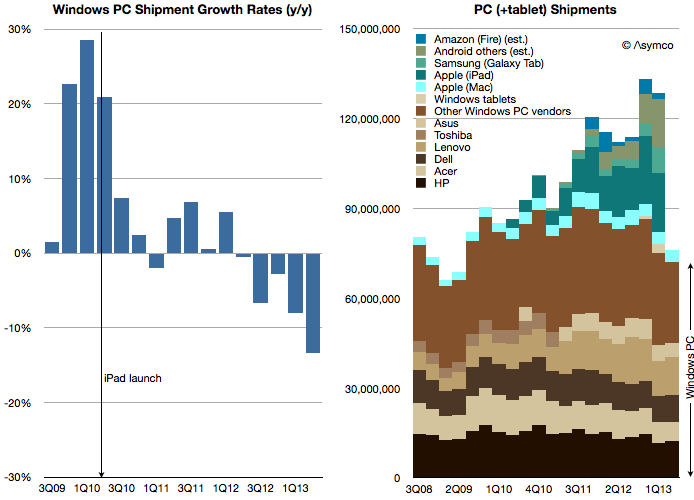
All that said, there is a special corner in Hell being reserved for the people that have to carry on in the private entity about to be created. The vast majority of the revenue, the supply chain, and the employee base are tied to a product stream that is in secular decline. The rumors are that they are thinking about a $2 billion cut in operating expenditures. (read massive layoff) As I have blogged previously, searching for loose change underneath the drivers' seat is no substitute for actually taking the wheel and trying to go somewhere. Meanwhile, Horace Dediu puts together some charts that tell a damning story about where the car is going:


What happens if sales keep declining? More cuts, maybe? What part of that growing market for Android, and iOS mobile devices does the Intel/Microsoft/Dell troika have? Let's ask the bigger question: How much is Dell really going to invest to keep a share of this market, and why do they keep talking about it so much? One thing is certain: If they are going to ramp up that enterprise business to replace client revenue, it will take a herculean investment to even get things close. The strategy of making small purchases to grow the business will not yield results quickly enough, nor is the prospect of having to integrate and manage all those organizations a particularly easy path. One is left to wonder if there aren't one or two really big transactions to follow this one. Then again, they are a private company now. Does it really matter any more?

With that, off to hit the scotch...


Wednesday, September 4, 2013

Thoughts on the MS/Nokia Deal: Software Now Comes in a New Box

Now that the dust is starting to settle a little from this weekend's hysteria over Microsoft's acquisition of Nokia's mobile assets, it probably is a good time to step back a little, take a deep breath, and think about what this means to the IT ecosystem. A good deal of ink and lots of electrons have been tortured on the Internets in breathless criticism of this deal. I think that its safe to say the usual suspects will always pop up to complain about what a horrible waste of money this is, and ostensibly, how it will mess up their carefully crafted, but meaningless financial models. Setting aside the finances, this move portends a lot of big things in the world of IT and application development. Let's walk through the list in order of obviousness.

The "New New Client" is Mobile and not MS

This can't possibly be the first time you are reading this, so I'll spare the details. Every decade or so, the predominant client architecture and it's user interface paradigm goes through a profound change. To what should be no one's surprise, it's happening again in a couple of distinct ways. Firstly, the world is going to touch interfaces. Apple's iPad can be credited for making this change stick. Secondly, the world's end users have now become inured with consuming application content on their phones. Again, Apple largely owns credit for getting this over the mass market chasm. Both of these things have a lot of repercussions if you are writing apps going forward.

What is different this time, is that the big client paradigm change was NOT driven by Microsoft. It was not influenced by Microsoft. In fact, it's hard to tell whether they were even in the room while all this was happening. So here we are, with Apple calling the shots, and the Redmondians are occupying the cheap seats. Back when I was much younger, Microsoft was the one doing the disrupting by forcing everyone to rewrite their apps for the Windows UI. This was one of the big reasons that MS succeeded in owning the PC by the early 90's. That this same strategy is now being perpetrated on their Windows platform is not lost on them. Clearly, this deal is a major part of getting their mojo back in their view.

There is a Change of Thinking Afoot in Redmond

Microsoft has always been as pure play a software company as can be imagined. Their recent trend has them veering away from that somewhat. I think this is very significant. For the last 15 years, the notion of "tin-wrapped" software has been steadily gaining credence. At first, the cognoscenti hated it because with the tin - and it's enclosed hardware - came costs, and hence lower profit margins. It has been proven, however, that this approach has a lot of advantages, especially when it comes to controlling and managing the customer experience. Intuitively, one can see that the more of the stack that a single vendor integrates, the better the customer outcome. The customer gets a more seamless, plug and play experience. The vendor also gets better lock in loyalty. Nowhere is this approach more evidently successful, than at Apple. (Oops. There's that name again.)

So, it seems that if you are going to make a technology product for mass markets, the right way to do it is to own as much of it as possible. Hence we see Microsoft making tablets (e.g. Slate), and now, they are going to be making phones. I am not going to opine on whether they can successfully pivot in this manner, but it is significant that they are slowly aligning themselves with what they see as working well in the market. They have done this before, and regardless of the outcome, they will make things very interesting for everyone involved.

If You Are Writing Apps, You Have Some Tough Choices Ahead

In the Web Era, the client was largely defined by a browser, HTML, and things like JavaScript, Java, OCX, Flash, etc. This is how you delivered your application experience to your user. That paradigm may have already Jumped The Shark as I write this. When all of the truly interesting, interactive user experiences are from natively written, touch enabled, mobile applications; the market will have to follow suit. Users will have spoken. This is already happening with services like Yelp, Uber, and Facebook, where usage has increased due to the quality of the mobile experience. Slapping an HTML 5.0 page in a browser window will be an obvious step down for a mobile user. 

Now that Microsoft has gotten religion on mobile and touch, you can be certain that it will tip whatever remaining part of the market that was on the fence. This means that app developers now need to think about native UIs for iOS, Android, and maybe even Windows. That's an awful lot of work, and some tough choices to make. For guys like me, it also means lots of cool new things to build. I love paradigm shifts.


Sunday, September 1, 2013

Sunday Night Scotch: Gelsinger Wrong About Intel/ARM, and May Need Help With Math

There's math, and then everything else is debatable...
- Chris Rock

One of the most spectacular wastes of my time over the last 5 years has been the incessant, relentless, and sometimes vacuous discussion about whether the world is going to be dominated by the juggernaut that is the Intel chip machine. You see, I used to work for a company that was so beholden to the idea that Intel would dominate, it didn't really matter what the argument was that was put up against it. Even if you won the battle today, the true believers would come back and reignite the the discussion a few months later, claiming that everything had changed. I'm a software guy. I really do not have a horse in this race. My stuff more or less compiles and runs on any architecture you want to go with. I do, however, want to make money. This is why the line of discourse that Pat Gelsinger took in a panel discussion last week seemed, well, a little off.  Specifically, those of you who were there may recall the tirade he made on ARM processors, saying Intel would win "even if you reduced the power consumption of ARM CPUs down to zero."

Perhaps I am suffering from Post Traumatic Stress Disorder resulting form my experiences of the last 11 years, but hearing that nearly caused me to hurl my coffee at the stage. Back in 2002, I used to think somewhat like him, but I got educated. It's about time that everyone else just ran the math. Intel is great if you are looking for a bunch of pizza boxes to sit in a rack and run VM's, but one only needed to take a walk on the show floor to realize that this is hardly the only use case out there. There is a reason why there is so much custom hardware on the floor. There is a reason why the EqualLogic storage arrays (and others) still run Broadcom. There is a reason why smaller form factor devices run almost anything but Intel.

The causes for which ARM-based and MIPS-based SOC designs will continue to succeed are numerous. Generally, they do indeed consume a lot less power, and, despite the fearless predictions of Mr Gelsinger (and others) this has a lot of consequences. Lower power consumption is not just a "tree-hugger's" value proposition. First, it means that a device does not need to have a power supply that sounds like the back side of a Boeing. It also means that the device need not have a heat footprint that NASA can track from space. In other words, I can put one of these devices on my desk, or on top of my TV, or in my audio cabinet. That alone opens up new markets.

More importantly, there's the simple matter of cost. Once you consider the compute power you get, the costs of additional network connectivity, and the other gizmos that are generally being included on the die with many of these devices, along with the power consumption and heat dissipation advantages, it really is no comparison. That doesn't mean that Intel will never be competitive in this area. For now, and for the last 10 years, that just hasn't been the case. The math always fails to support the rhetoric, as much as many would like it to. Despite this, we all are continuously subjected to relentless propaganda from the guys who have bet the farm on one architecture.

My suggestion: Even if you don't fully buy into an opposing view, it's always useful to have a hedge. Large software codebases inexorably tied to a single vendor's hardware can become strategically vulnerable to disruption. Perhaps this is one reason why Microsoft has brought back the ARM port of Windows. That, and the fact that they want to make money from the increasingly large installed base of ARM devices. Which brings me to my last suggestion: never, ever, let religion get in the way of making money.


Friday, August 30, 2013

Dispatch From VMworld: Surprise! It's Still All About The Box.

Its only the second day of what is the biggest IT conference out there these days, but I think I can already see the direction that things will be going for the next couple of years. We all like to believe that we are heading onto a post-virtual "cloud" era for computing infrastructure. Certainly, if you listened to the panel participants, we are all going to be devoid of any physical computing infrastructure someday soon. It will all magically migrate to vast data centers in the desert, leaving us free to interact with it through processors in our phones, cars, watches, underwear, etc.

So then I went to lunch with one of my former colleagues from Dell. We talked through the usual pleasantries and then we got into the happenings at the show. "You know," he says, "it's still all about the box." "Yes," I replied. "Everyone is fighting about who owns the box. Nothing has changed."

The box, in this case, is your server, or your storage, or your network. By virtualizing them, we really haven't changed the discussion much. We only changed the venue. The new NSX (nee Nicira) product is an obvious play to redefine the edge of the network, to the exclusion of Cisco. Nowhere was the tension more evident than on the stage, where Cisco distinguished itself simply by it's absence from the list of partners. I've made my opinions on the networking space known elsewhere on this blog, but kudos to VMware if they can actually succeed in shaking up the space a little.

Then there's storage. If you haven't noticed, it's nothing but boxes there. Physical, ever-expanding, power sapping boxes. There, you see a whole host of players trying to collapse your storage into your server, or replace your old storage arrays with new ones that contain flash, or maybe throwing some flash into your server and then collapsing. Of course there are the products that push you to just use servers as storage arrays - VMware's distributed storage software, for example. No part of the box is more hotly contested than this one. Here, it's not clear that there is going to be a single winner, for the simple reason that there is just too much data to manage in too many different ways. (Hence, a reason to gravitate to this market for new ideas)

When you juxtapose the battle for the box against the lofty cloud talk that Andreesen and company were spouting up on the stage, its hard to draw a linear transition from the real world to the vision. Perhaps vision is just that: an aspirational goal that is not intended to be achieved. I'm not sure that I even want cloud-connected boxers. Perhaps for consumer IT, the vision is easily achievable. In enterprise IT, the legal, security, and psychological hurdles just seem to generate far too much inertia to get us there. If you are a strategist, it seems foolhardy to bet that IT will be physically gone in 5 years. Hence, we have to place our bets on some fuzzy, semi-cloudy, hybrid middle ground.

Lots to think about.


Thursday, August 8, 2013

Storage Seems Exciting and Networking Seems Dull

I have to apologize for not posting, as I've had a pretty busy week traveling to the Bay Area for meetings with investors and other assorted smart people. As some of you know, trying to define a product - and a business around it -  is generally a difficult thing. Lots things to think about, so let's dive in.

One of the things that I keep bringing up in conversation around here is the notion that I rudely expressed in the title of this post. Taking it down to the next level: If you were to come up with a new datacenter innovation, would you want to make it part of the networking infrastructure, or something else? What the hell has happened to innovation in the networking space, anyway? Sadly, the title of the post is pretty close to my conclusion... for now. After talking to a lot of folks, from a lot of different parts of the value chain, I got a lot of different perspectives, but really all pointing to the same conclusion. It's enough to get you depressed. Here's what people see:

Adoption curve - It used to be that network ports were like chocolate covered coffee beans in my office. You couldn't get enough of them. Moreover, there were manifest bottlenecks everywhere in the topology. Nothing was more urgent to a growing business than getting more, faster ports as soon as possible. Alas, this has changed a lot. The transition from 1G Ethernet to 10G is still not complete years after the technology was first introduced. Further, workloads that can fill those pipes are not commonplace. Except for some unique, large scale situations, IT does not see the need to go beyond current technology for a while.

Sales motion - The above adoption rate has led to a much longer sale cycle, and the expected life span of networking gear has grown commensurately longer as a result. Servers and storage get replaced every 2 or three years. Both get add-on investments as capacity is needed. Networking gear replacement has become a 5 to 8 year event. Put most succinctly by a reseller friend, "I can sell you storage today, and return to sell you more in a few months. I sell you switches, and then I have no reason to call you for 5 years." Add to that the obvious truth that one vendor dominates the space in a way that causes resellers great discomfort, and the general reluctance to compete is understandable. It just isn't fertile ground to grow new businesses.

Burden of Innovation - While nothing is more thorough than the interoperability testing that goes on in networking, it has a cost. Network infrastructure is completely closed. What does that mean? In order to propose a new innovation in the networking space, it is nearly impossible to do it on existing gear for technical reasons. Standards have reduced network management to a completely decoupled state, where all control plane services are inaccessible to software running outside the switches. There's nothing to be done with the standard interfaces. This means that the way to innovate is to build switches. Of course, if you build those, you quickly have to face the adoption curve issue, and the sales motion problems.

For a lot of reasons, many people might be reminded of the old stove-piped systems of the 70's and 80's when they look at the space. The typical approach back then was to build a new hardware platform, build an operating system (or buy some UNIX code from AT&T) and bring up the new machine. Then, you could build the pieces that make you different.

Isn't this what SDN is about? Well, yes. Software Defined Networks have the potential to change this pathology, but the evolution of the technology is taking some bizarre twists that make it a scary place to start a business. This is probably the subject of another post, but suffice it to say, if a reasonable person can't see a path to implementing a new forwarding algorithm on a network without building the entire stack from scratch, it will all fail.

So there you have it. The only counterpoint I can offer is that I remember a time when networking was exciting and storage was dull. I'd love to hear more thoughts from all of you.. especially if you disagree. What say ye?

Monday, August 5, 2013

Sunday Night Scotch: Do I see Checkmate? Did Michael just win?

So, the big news going into the weekend was the outcome of the latest round of negotiations between the Silver Lake/MSD team and Dell's buyout committee, as Arik Hesseldahl notes in the Wall Street Journal:

Michael Dell and Silver Lake Reach Last-Minute Buyout Deal

People have constantly hit me up for insight that I could not provide in this situation. Now that I am free of any financial interest in the transaction and I am truly a spectator,  I must say I am having fun watching this. The truth is that even the execs inside of Dell were pretty much in the dark about the machinations surrounding "the transaction". I can honestly say that anything I type here is strictly a thought manufactured by my own brain, and publicly available information. It's also my own opinion. You get what you pay for... so let's pour ourselves a good single malt and walk through the data, shall we?

As described in the referenced article, Silver Lake et al. have basically raised their bid to $13.96 per share for all the outstanding shares of the company.  As you know, the rival bid is an enigmatic $14 per share for some fraction of the company. Carl Icahn, while quite noisy, really hasn't done a lot to put a credible offer on the table. At that price, he is willing to buy some unspecified number of shares, depending on who wants to sell. I'm sure he is serious about what he says, but his actions betray what appear to be a set of short term profit goals. (I am not going to go into the game theory of what happens if everyone wants to tender at $14 and he only has the money for some fraction of the shares... could happen, though). Suffice it to say, it looks like MSD is winning right now: $13.96 per share in cash vs. something... umm... close to that, in the case of Icahn.

All of that is a distraction to what is really going on: You have a $60 billion+ revenue stream with a substantial part of it in a state of secular decline - and you have this "going private" thing. So here's my shocking opinion: This has nothing to do with going private. This is about WHAT gets done to fix it, and, of course, WHO profits from a successful outcome. MSD and company think that this is not for widows and orphans. In essence, they are saying, "If you have no risk tolerance, you better get off now. Here's some cash.".  For reasons I will outline shortly, I believe that they are very right about this.

On the other guard rail, you see Carl Icahn pounding the table that you are all being ripped off. Well, he is right, too: If all of us were comfortable with the set of risks involved with this sort of turnaround, and it turned out to be successful, he is absolutely correct. That is a very bad assumption, though. Widows and orphans do not invest in high risk leveraged turnarounds. Carl Icahn does. Enough said.

As for the deal itself, it is not very hard to run the discounted cash flow analysis yourself and figure out what the whole thing might be worth. In this article, Chris Nichols provides a nice model for you to play with. Just click here for the spreadsheet and run your numbers. Hint: It all hinges on what the profit margins are of the future entity. If you believe, as he does, that this is just a PC client company with 17% gross margins, then the current offer is a fair price. If, on the other hand, you believe that the current margins in excess of 20% are sustainable and can grow higher, then it is easy to see how money can be made from the deal. It is all about what you believe, and whether you think the rewards are worth it. Would you take a crazy risk for a 100% return? Do you need a higher return than that to justify the risk? What is the likelihood of a higher payout? If Icahn is so sure, why doesn't he just buy the whole company instead bringing along the widows and orphans? As you can see, this is not easy stuff to think through.

In the end, the real issue is the WHO part of the above equation. Is it MSD or Icahn who will get the better outcome and reap its benefits? In my short experience trying to raise venture money for my own company, I have a hunch that the guy whose name is on the door has the right motivation. I do not know that he has the gumption to make all the right decisions, but frankly, I cannot see how the current sole alternative will result in a more profitable outcome. Moreover, unless a better, more credible offer is in the works, the best hope for the dissidents is to try to somehow get folded into an equity stake in the private entity. After all, they seem to talk like they have the risk tolerance for it. In a private Dell, they may be able to structure themselves a deal where they get a lot better than a 100% return. Who knows what happens this week...

Disclaimer: This is just my opinion. Have fun with it, but don't try to tell me that I know anything you couldn't have figured out yourself.