Showing posts with label Hype. Show all posts

Sunday, November 17, 2013

Can A Slingshot Take Down The AWS Juggernaut?

If your purpose in life is to entertain the gods, you might as well put on a good show.
 --Unknown

Amazon's Re:Invent show last week turned out to be quite a coming out party for the predominant infrastructure service provider. There were a number of interesting announcements that moved the stocks of perceived competitors, and of course, there was a disproportionately large showing of attendees at the Venetian in Las Vegas. For me, the highlight was provided by good friend, and super smart VC, Jerry Chen, who went on  The Cube to lay down the gauntlet starting at about 7:00 in the video below:


Watch live video from SiliconANGLE.com on Justin.tv

The salient point Jerry made was the comparison between an ascendant Amazon AWS and the now-decidedly incumbent Microsoft circa the 1990's. His argument is that there are really two investable bets to make (well, he said three, but the third is less interesting to me). The first is that there are companies to be formed that can make AWS more enterprise-ready, and the second is that you can invest in someone that will take down AWS. If nothing else, it is heartening to see Jerry has taken up the mantle of the venture capitalist, and has pointed to the next big hill for the army to conquer. As entrepreneurial cannon fodder in this battle, I greatly appreciate the affirmation.

Well, since I can't sleep well on airplanes, and I had the misfortune of taking an overnight flight home from Las Vegas, I had plenty of time to think about this matter. After reaching back into my memories as a newly minted engineer in 1991-1993, it is obvious that history does indeed rhyme if it does not repeat. Hence, I think I have come to a conclusion on which will be the better bet if I were investing venture money right now.

A Tale of Two Microsofts

Having the pleasure of attending some of the original Win32 Developer's conferences, the Microsoft PDC's, during the early 90's, as well as the WinHEC conferences up until 2008, I had a semi-privileged, front row view of the revolution that Microsoft led over the course of a decade. Given the day-to-day reality in which we operate, it is easy to forget that the world at the time of the 1993 PDC was radically different than what we have today. In fact, most readers may find my observations of being a Windows "dev" back then quite amusing.

As I recall, developing code for Windows before Windows NT was released was a trying process. The development tools before Visual C++ were not that friendly. The operating systems were either very buggy and unreleased (as in the 32 bit NT), or super-duper buggy and shipping (Windows 3.0, 3.1, 3.11). In the case of the latter releases, you had no meaningful memory isolation between tasks, and so a simple coding typo could take down the whole box while you were working. Having learned to code in the Berkeley and AT&T UNIX operating systems, it felt like I was playing with a toy rather than a tool of enterprise transformation.

Back then, the "real" systems that businesses ran on were either UNIX-based mid range servers, or mainframes. The PC client was really just an over-powered terminal that also had some desktop apps, as well as file and printer sharing. Strategy discussions in PC software companies centered around how overpowered the clients were in comparison to the big iron, and what that fact foretold about the future. Indeed, the developers' conferences were largely full of optimistic young developers trying to change the role of the PC architecture. The rhetoric coming from Gates, Ballmer, and Allchin included lots of chest-pounding bravado about how good the next generation would be, and how it would take on a huge role in the enterprise - if only we developers would agree to write awesome new apps for Win32. We all would go home with palpable excitement and a religious zeal.

A little over a decade later, the world was radically changed. Perhaps not for the better. Substantially all of the mid-range systems vendors had vanished. Windows was dominating both the client and well as the back office of enterprises everywhere. The ecosystem that had developed all those awesome Windows apps had largely been cannibalized by Microsoft, and all those developers had moved on to writing web apps or other cool, Linux-based  things that were out of the way of the perceived MS predatory machinery. It was here that compute and storage virtualization emerged as dominant technologies. It is easy to argue that AWS and VMware tipped the datacenter market from the new incumbents right here.

Amazon Looks More Like the MS of the 90's

Last week's conference was full of developers. The rhetoric brought back memories of the 90's. The show floor was full of small, venture-funded companies. The representatives of the big incumbents were trying to make themselves invisible. Everyone, including the VC's, were talking about how AWS was not ready for the enterprise - yet. Although rumors suggest that AWS is a $5 billion revenue stream, it does not look like the big players are using it yet.

It's hard to envision that AWS can be tipped over when it's user base is not the demanding enterprises that make up the bulk of IT spend in the market. The fact that it got to this point based on the grass-roots support of a big developer community makes it very scary. People are right to be afraid that this company could be the next big IT monopolist. However, if you are an investor, would you consider it an easier bet to take them down, or to help them achieve the dominance they seek? The key, in my opinion, rests with Amazon. If they take a page from their neighbors in Redmond, and eat their ecosystem, the community will move on very quickly, and the bet is an easy one.


Saturday, September 28, 2013

Software Defined Storage - Zombie Box Huggers are Winning

In all honesty, I first submitted the abstract for a talk on Software Defined Storage to SNIA very early this year. It seemed like a different world then, and I really had no idea what I was getting into. For the purposes of full disclosure, I was the sponsor for an SDS project before I left Dell, and so I had spent a lot of time sifting through all the data and the nonsense that surrounds it. It felt apropos to put together a talk on what we had learned about the topic: the use cases, the technologies, the market, and the business. In the intervening months, something happened out there to cause the topic to become an epic technological hot potato. I've now given two talks at two separate conferences, and served on two panels, all in the vain attempt to place a clinical definition on SDS. I don't think that such a definition will be possible. Additionally, I want to make it clear:  I am a skeptic when it comes to the products on the market today. Let's talk about my somewhat slanted viewpoint:


SDS is Like Tobacco...

While this may sound like a cruel metaphor, it is apt. You can substitute alcohol, or any other recreational drug here, but the relationship would be the same. There is a short term buzz you get from the products, but there are long term problems and dangers that need to be managed. The sellers are fundamentally hoping that you are adult enough to not go on a bender and crash your car, or destroy yourself in some way, so you can keep coming back. There are use cases where the products work, but one should be very wary of assuming that, in a super-competitive industry, storage arrays are so massively mis-priced that it is economically advantageous to construct one from parts. Integration and testing is a huge task that effectively "de-commoditizes" all of the storage products available today. A bug that has a .1% chance of occurring may seem like an acceptable risk with 4 disks. With 100 disks, you have a different calculus to consider.

One of the comments that I heard at SDC is that we have effectively unlearned all the things that we learned 20-30 years ago about creating resilient systems from cheap disks. This isn't entirely true. What we have learned is that there may be better ways to get storage resiliency at very large scale. It's a sexy concept, and those who think they have the physical scale necessary owe it to themselves to try it. Those without cloud-sized data centers need to consider the possibility that the best bet is to rent disk space from companies that have the mass, i.e. Amazon, Google, etc. Trying to convince someone that they can be Google or Amazon if they only just bought your software, is much like selling steroids to people who don't work out. Nice story, but missing key facts.


The Box Huggers Are Not Who You Think

It has been a long-speculated axiom of storage that the people want boxes. If you want to sell storage, you need to put it in a metal box and sell it. Upon much contemplation and discussion on the topic, I have come to the conclusion that his has more to do with economics than anything else: customers are used to buying capacity and sellers are used to selling in the same manner. In fact, there are very few people who have gotten past the notion of paying for something other than capacity. Generally, this is how storage works: you have some data of a particular size, and you want to put it in storage commensurate with that size.  The more hazy your needs are, the more likely you will overbuy and hence overpay for your need.

It should not be a surprise then, that the people who are most religious about clinging to boxes tend to be those who are selling them. In full disclosure, I have to confess that I may be one of this cohort. It really represents the easiest way to comprehend what you are selling and what the customer is buying. You would like to be able to offer X Terabytes of highly available storage, with quantified performance, up to N LUNs, up to M snapshots, etc. This is really an indication of tested limits more than anything else, and it should be construed as a support statement from the vendor to the customer. Without that metal box to test, guaranteeing any level of performance or functionality can quickly spiral into an unbounded problem. Hence, we love boxes more than anyone. Perhaps this is why many perceive that the market is troubled by the encroachment from the cloud scale services such as Amazon's and Google's. Nonetheless, the box hugger's view of the world is that any product without clearly defined and testable performance objectives is fundamentally a toy.


Most Customers Are Actually Data Huggers

In my wanderings over the last decade, I have met many, many customers who buy and manage infrastructure. The one most important commonality among all of them is how tightly the security of their employers' data is tied to their success. The word "security" in this case is not to be understood as only protection from intrusion, but also its availability, performance, and the general control of its destiny. That last item - control - is perhaps the most important of all. Putting their data in the cloud gives them the same detachment that they get from sending their kids off to college. Risking data loss is so unacceptable, that making copies and scattering them in as many places as possible seems to be de rigueur. That is pretty paranoid.

This should be a hint to everyone. There is a mentality evident among many software vendors that their role in providing the aforementioned security can be conveniently redlined above the disks or the hardware platform or the network. I don't think that there is a bias against software only solutions. Rather, it's evident that the data-hugging masses aren't getting the feelings of security that they need to widely adopt the approach. As I said in the panel discussion last week, this is less of a technical problem and more of a business model problem. If a model exists that allows the technology to be delivered to customers with the warm, fuzzy feeling of control, I'm sure this market will find it. I don't see one right now.

So what will happen? Without some major redirection, it's clear that there is going to be a shakeup of sorts in this space. The minority of shops that have the expertise, the mandate, and the spare time, will make their choices. The bulk of those choices will be for free software because that is the easiest way to rationalize the internal support costs of the do-it-yourself approach. In the end, the paying market for many of these solutions will not be large enough to support all the players. The winners will be either open source (i.e. profit-free), or solutions incorporated into existing platforms at no extra cost (watch VMware and Microsoft here). Finally, without addressing the needs of the data hugging mid-market, its hard to see any of these products seeing more than limited acceptance.

I'm pretty flexible with my opinion. I change my mind when the facts before me change. Right now, this is what I believe.

Monday, September 16, 2013

Dispatch From SNIA SDC: Hardware Defined Software


Much to my surprise, the most contentious portion of my June SPDECon discussion on software-defined storage was the seemingly innocuous slide I added at the end: In it, I simply decreed that hardware widgets couldn’t be a part of a software-as-storage solution.  This seemed to be a self-evident assertion and, accordingly, I put it at the end of my slides thinking that no one would notice it.  We never got to the Q&A part of my talk because this discussion usurped all of the extra session time.

After a good amount of thinking on the subject, I think I have changed my mind somewhat. Software defined storage is tragically a hardware-constrained technology. We run out of compute cycles, and the speed of light may be too slow. These sorts of vexing architecture problems are more directly and easily solved with specialized hardware.  Clearly, the people in the room last June who made a living from solving problems with hardware had a legitimate concern. After that smack-down, I have done fair amount of evolution on my thinking on hardware in a software-defined world.

It is looking like I will be doing the same talk again tomorrow at SDC. This time, I am using a different deck. It might turn out to be a bit more depressing if you are expecting a cookbook on how to build SDS. While I am not going to spoil my own discussion topic, I will say that it is instructive to look at places where platform properties have successfully been abstracted, so that the software doesn’t cease to work when specific hardware is missing. One example of this is the advanced SCSI functionality that has gone through standards over the last few years. VAAI, ODX, and the like are all hardware specific functions that make life substantially better for people without de-virtualizing their virtualization platform.

All that said, I’m sure I’m going to learn something new again… 

Friday, September 13, 2013

My Stock Got Involved in a Bidding War With a Carl Icahn, And All I Got Was 30 Cents

I really can't resist commenting about this topic, so even though it might bore many of you, I'm going to delve into things Dell for one last time... at least for now. As you must surely know, we were greeted on Monday morning with news from all manner of news outlets that the Ichan-led consortium had decided to pull out of the running for acquiring Dell. As reported at the WSJ today, it looks like the takeover is now a done deal: (link may require a subscription)

Dell Shareholders Approve Buyout

So, barring any last-minute heroics from unknown parties, it looks like the original deal proposed earlier this year is going down largely unchanged from its original terms. This leaves us with a lot of things to ponder going forward about the business of being an IT infrastructure player. As I blogged previously, the deal also presents an interesting barometer of risk tolerance in the post bubble, post-2008 world. Finally, there's the fact that corporate raiders... err, I mean activist shareholders... seem to have jumped the shark with this deal.

Let's deal with Icahn first, since he has been an endless source of amusement for me. I love, love, LOVE it when a guy like him parrots democratic principles while trying his best to squeeze money out of anyone he can. One thing that I have learned over the years is that a corporation is anything but a democracy. Frankly, large or small, its much closer to a dictatorship when it works best. There is one important distinction: if you are an employee, customer, stockholder, or all of these, you can feel free to walk away at any time. You can even sell the stock short and say mean things on message boards. Except for that, it's just a matter of scale. Are we with Fidel, Saddam, or Lenin? The notion that the shareholders can tweak management is valid only on the margin and in extreme cases. Maybe you can argue that Dell was such a case, but, as you can see, it was very easy for management to do what they saw fit. Management sets the rules, and then can change them as is expedient. If you want to fire them all, you best have a plan to replace them quickly, lest you become the guy that has to run the place.

Which segues into the second point: Icahn clearly never wanted to buy Dell. He never had the money to buy Dell. Even if he had the money, he had no credible plan to rehabilitate Dell. Heck, I'd be astonished if he could carry Michael's briefcase successfully. When Blackstone bowed out earlier this year, he had an opportunity to gracefully leave the table with a profit, and spare himself the embarrassment of last week. If he really believed in the value proposition of owning a private Dell, he could have toned down the incendiary rhetoric, and tried to roll his position into a stake in the new entity. There were so many ways to win... Instead, he lost a very public battle in a circus setting of his own creation. As a result, everyone now knows what his credit limit is. Everyone now knows when he's in over his head. He's going after Apple now, which is 20 times the size of Dell. I wonder how worried the guys in Cupertino are these days.

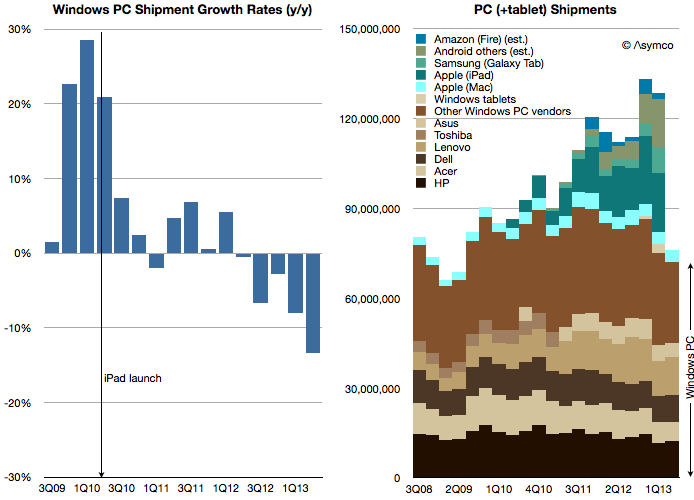
All that said, there is a special corner in Hell being reserved for the people that have to carry on in the private entity about to be created. The vast majority of the revenue, the supply chain, and the employee base are tied to a product stream that is in secular decline. The rumors are that they are thinking about a $2 billion cut in operating expenditures. (read massive layoff) As I have blogged previously, searching for loose change underneath the drivers' seat is no substitute for actually taking the wheel and trying to go somewhere. Meanwhile, Horace Dediu puts together some charts that tell a damning story about where the car is going:


What happens if sales keep declining? More cuts, maybe? What part of that growing market for Android, and iOS mobile devices does the Intel/Microsoft/Dell troika have? Let's ask the bigger question: How much is Dell really going to invest to keep a share of this market, and why do they keep talking about it so much? One thing is certain: If they are going to ramp up that enterprise business to replace client revenue, it will take a herculean investment to even get things close. The strategy of making small purchases to grow the business will not yield results quickly enough, nor is the prospect of having to integrate and manage all those organizations a particularly easy path. One is left to wonder if there aren't one or two really big transactions to follow this one. Then again, they are a private company now. Does it really matter any more?

With that, off to hit the scotch...


Sunday, September 1, 2013

Sunday Night Scotch: Gelsinger Wrong About Intel/ARM, and May Need Help With Math

There's math, and then everything else is debatable...
- Chris Rock

One of the most spectacular wastes of my time over the last 5 years has been the incessant, relentless, and sometimes vacuous discussion about whether the world is going to be dominated by the juggernaut that is the Intel chip machine. You see, I used to work for a company that was so beholden to the idea that Intel would dominate, it didn't really matter what the argument was that was put up against it. Even if you won the battle today, the true believers would come back and reignite the the discussion a few months later, claiming that everything had changed. I'm a software guy. I really do not have a horse in this race. My stuff more or less compiles and runs on any architecture you want to go with. I do, however, want to make money. This is why the line of discourse that Pat Gelsinger took in a panel discussion last week seemed, well, a little off.  Specifically, those of you who were there may recall the tirade he made on ARM processors, saying Intel would win "even if you reduced the power consumption of ARM CPUs down to zero."

Perhaps I am suffering from Post Traumatic Stress Disorder resulting form my experiences of the last 11 years, but hearing that nearly caused me to hurl my coffee at the stage. Back in 2002, I used to think somewhat like him, but I got educated. It's about time that everyone else just ran the math. Intel is great if you are looking for a bunch of pizza boxes to sit in a rack and run VM's, but one only needed to take a walk on the show floor to realize that this is hardly the only use case out there. There is a reason why there is so much custom hardware on the floor. There is a reason why the EqualLogic storage arrays (and others) still run Broadcom. There is a reason why smaller form factor devices run almost anything but Intel.

The causes for which ARM-based and MIPS-based SOC designs will continue to succeed are numerous. Generally, they do indeed consume a lot less power, and, despite the fearless predictions of Mr Gelsinger (and others) this has a lot of consequences. Lower power consumption is not just a "tree-hugger's" value proposition. First, it means that a device does not need to have a power supply that sounds like the back side of a Boeing. It also means that the device need not have a heat footprint that NASA can track from space. In other words, I can put one of these devices on my desk, or on top of my TV, or in my audio cabinet. That alone opens up new markets.

More importantly, there's the simple matter of cost. Once you consider the compute power you get, the costs of additional network connectivity, and the other gizmos that are generally being included on the die with many of these devices, along with the power consumption and heat dissipation advantages, it really is no comparison. That doesn't mean that Intel will never be competitive in this area. For now, and for the last 10 years, that just hasn't been the case. The math always fails to support the rhetoric, as much as many would like it to. Despite this, we all are continuously subjected to relentless propaganda from the guys who have bet the farm on one architecture.

My suggestion: Even if you don't fully buy into an opposing view, it's always useful to have a hedge. Large software codebases inexorably tied to a single vendor's hardware can become strategically vulnerable to disruption. Perhaps this is one reason why Microsoft has brought back the ARM port of Windows. That, and the fact that they want to make money from the increasingly large installed base of ARM devices. Which brings me to my last suggestion: never, ever, let religion get in the way of making money.


Monday, August 19, 2013

Relax, man. We Are Only Looking For Your Metadata.

I've always been known to be a cynic. There is, in fact,  something inside my brain that trips the minute I start to partake in any kind of exuberance over matters related to technology. But even in my most hype-averse moments, I never imagined to think as skeptically as James Glanz, who penned a most sober article in this weekend's New York Times:

Is Big Data An Economic Dud?

After pointing at the reams of data being collected by everyone from Amazon to Google, and all of the hype surrounding its purported value, he gets right to work:

There is just one tiny problem: the economy is, at best, in the doldrums and has stayed there during the latest surge in Web traffic. The rate of productivity growth, whose steady rise from the 1970s well into the 2000s has been credited to earlier phases in the computer and Internet revolutions, has actually fallen. The overall economic trends are complex, but an argument could be made that the slowdown began around 2005 — just when Big Data began to make its appearance.

So, let's calm down a minute and really draw a few distinctions about what has happened recently versus what has been happening for quite some time. It is very easy to conflate the old with the new in this space, and then easily draw the wrong set of conclusions.

There's a field called Operational Research that has been around for quite some time that looks, feels, and smells just like Big Data, but it really isn't as bleeding edge as one might think. Mostly because it seems boring, not a whole lot of people have noticed it. Rest assured, though, it has been making your life better and creating tons of economic value. That the fact airports schedule all those flights, quants at hedge funds squeeze out all those pennies, and UPS manages to deliver more packages every year without clogging every city with brown trucks is evidence towards that. (Stupid fact of the day: If you follow a UPS truck through the city, you will notice that they do not make left turns. Faster that way.) The old economy has been using OR to increase efficiency for decades, and it is probably one of many reasons that productivity continued to climb through the 90's.

There is a "new new" thing that, depending on who you ask, is still largely untapped. This is all of the metadata that gets generated when the world creates transactional data. The sheer size and scope of this makes it "Big" - it challenges the limits of the compute infrastructure that companies have to apply to it. To make matters worse, much of it is unstructured - it does not live neatly in the rows and columns of a database. You can't just throw up some SQL queries on it. Unless you understand it deeply, you don't even know what the relations would look like.

What is this stuff? Think of all of the log data from all of your servers and virtual machines. Consider all of the time stamps and file sizes, or maybe how many of the videos posted to YouTube are of kittens. There's a huge amount of intelligence there that can be leveraged to improve efficiency of your business in the same way OR has helped in the past, but the tools are not fully cooked.

I would argue that Google and Amazon, and the like have done a truly outstanding job of leveraging this metadata to streamline their businesses. This, and the hype, is why their stock prices are as stratospherically high as they are: They are far more efficient at targeting ads, moving goods, etc. than their old world peers. Sadly, they are just a small part of the economy. Leveraging all that metadata in every business requires insight, intelligence, and tools. These aren't there yet. Hence, its a bit premature to sit there tapping your toe waiting to feel the effects of the Big Data revolution.